
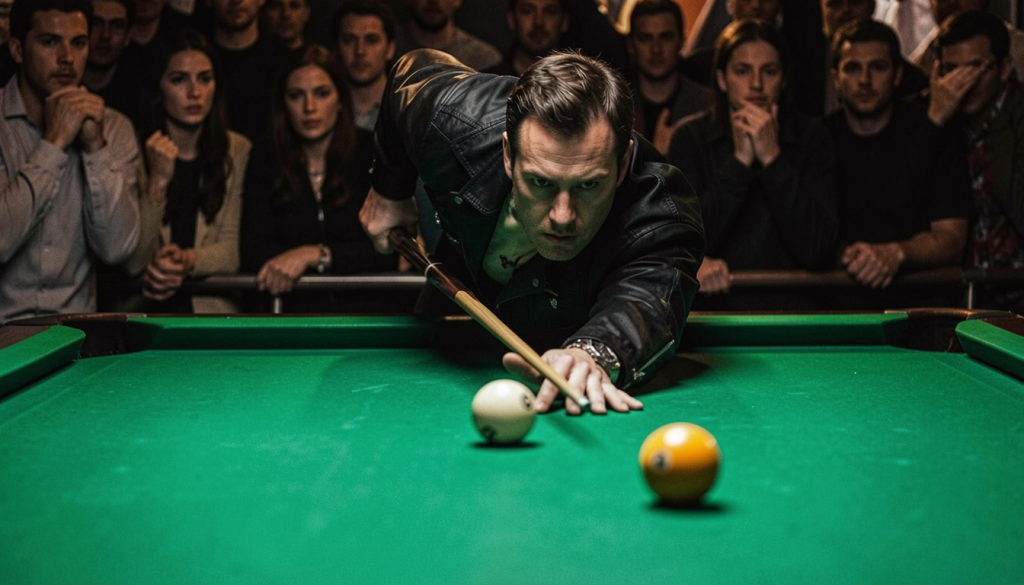
Playing Pool Under Pressure, makes more than skill. It tells personality and attitude. Furthermore, the book Life through the Pool dwells on this impactful concept in detail. The writer presents a struggle and recovery process. The pool was not just a sport anymore. Rather, it came to reflect life. One shot needed concentration, discipline, and bravery. Similarly, life requires the same attributes on a daily basis. Patience and adaptability are revealed to the readers through this story. They are also aware of the relevance of the mind training for pool players and personal development. As a result, the book is inspirational and instructive.
The Hidden Message of Playing Pool Under Pressure.
There is a lesson in Playing Pool Under Pressure because of the pressure. Rather, it develops emotional capability and recognition. To begin with, each shot requires a critical thought process. Then the gamer should remain calm and concentrated. Thus, pressure will be a teacher. The book describes the way that the game and life are influenced by strategy. Moreover, failures are lessons, not mistakes. Patience and adaptability gradually become an attitude and develop through repetition by players. The same can be said of the mind, which becomes stronger with experience. Consequently, with time, this process enhances confidence and discipline. As a result, the game becomes a means of self-development. The importance of mind training for pool players is another point that is found by many readers. It is a mental practice that enhances on and off-table decisions.
Focus and Strategy in Playing Pool Under Pressure.
It takes a lot of mental discipline to play pool under pressure. To start with, players need to learn the angles and time. Then, they are to manage feelings on challenging shots. As such, concentration is the most useful ability. The book brings out the role of strategy in leading every movement. Similarly, life demands a considerate choice during stress. Practice makes the players have patience and adaptability. These attributes assist them in remaining composed even in the face of adversity. Besides, clarity of the mind enhances performance in moments of competition. This concept is related to the mind training for pool players. When the mind is even, the actions will be accurate. Consequently, the game becomes an educational process concerning control, perseverance, and consideration of plans.
Training Resilience and Mind of Pool Players.
The core of the message in the book is resilience. The author experienced a traumatic brain injury and lost several of her abilities. But willpower gradually girded him in his life around. So the pool turned out to be a way of healing up and education. The training sessions empowered the mind and confidence. Moreover, the mind training of pool players was part of this experience. Mental exercises assisted in regaining focus and decision-making. Concurrency progress was led on, at the same time, by patience and adaptation. Minor changes brought bigger changes in the long run. As a result, readers observe the way discipline determines recovery and success. The novel demonstrates that the mindset usually counts more than talent in both sport and life.
Life Wise on the Pool Table.
A pool table usually mirrors the daily struggle. The first is that players assess situations prior to every shot. They then change direction in times of failure of plans. Thus, it becomes necessary to be patient and flexible. These capabilities are also applicable in real-life choices. The book states that each missed shot teaches something new. Similarly, failures offer growth prospects. Reflection gives players strength in their patterns of thinking. Mental training of pool players aids in keeping them cool in times of indecision. As such, they understand how to react rather than to respond. Balance and awareness is learnt with time in the game. So, the pool is not just recreation. Rather, it is a discipline, a strength, a prudent life practice.
Personal Development with the Game.
Self-awareness can be an initiation to personal development. The book illustrates this point using effective narratives. But obstinacy gradually brought about change. The game is what formed a tougher mindset. Moreover, patience and flexibility led to the day-to-day improvement. Every second at the table had to be concentrated and controlled. Slowly, the confidence came back through practice and reflection. Also, the mental conditioning of pool players enhanced focus and decision-making. This habit later spilled over to other lives outside the pool hall. As such, the lessons go way beyond sports. People can understand that success starts in the mind and builds with hard work.
Conclusion
The result of Playing Pool Under Pressure is later equated with life as a metaphor. The book demonstrates how struggle may result in influential developments. Discipline helped the author to revive his capabilities and self-confidence. In addition, patience and flexibility are some of the strengths, as emphasized in the journey. Every roll at the table is a decision that we have to make every day. Similarly, winning takes concentration, endurance, and wise moments. Another thing that the readers learn is the importance of training the mind in playing a pool and life. The resilience of the mind defines the way of tackling and conquering difficulties. Thus, the lessons go much deeper than the game itself. Ultimately, the practice of playing pool under pressure will teach that it is actually the state of mind that governs victory.